
Why AI Investments Fail Without a Modern Data Foundation?
The next wave of competitive advantage will not be determined by who adopts AI first—but by who is prepared to use it effectively.
Enterprise AI does not create value in a vacuum. When data foundations are fragmented or inconsistent, AI amplifies existing operational inefficiencies rather than business value. Sustainable AI ROI begins with enterprise data readiness.
Artificial Intelligence has rapidly evolved from an emerging technology to a strategic business imperative. Across industries, executive teams are accelerating investments in Generative AI, intelligent automation, predictive analytics, and AI-powered decision support to improve productivity, enhance customer experiences, and create new sources of value.
Yet, despite unprecedented levels of investment, many organizations are struggling to translate AI ambition into measurable business outcomes.
The challenge is rarely the AI itself.
It is the enterprise's ability to provide AI with trusted, connected, and contextual data.
As organizations move beyond experimentation toward enterprise-scale AI, a clear pattern is emerging: companies with mature data capabilities are realizing tangible returns, while others remain caught in cycles of isolated pilots and limited adoption.
The difference lies in the strength of their data foundation.
01 AI Has Elevated Data from an Operational Asset to a Strategic Capability
For years, organizations viewed data primarily through the lens of reporting, compliance, or operational efficiency. AI has fundamentally changed that perspective.
Data is no longer a byproduct of business operations—it has become the core enabler of intelligent decision-making, automation, and innovation.
Every AI-generated recommendation, every predictive insight, and every autonomous business process depends on the quality, accessibility, and governance of enterprise data.
When that foundation is fragmented or inconsistent, AI does not amplify business value—it amplifies existing inefficiencies.
This is why many organizations discover that their greatest AI challenge is not model development, but enterprise data readiness.
02 The Gap Between AI Ambition and Enterprise Readiness
Boardrooms increasingly recognize AI as a catalyst for growth. However, enterprise data environments often tell a different story.
Business-critical information remains dispersed across legacy applications, cloud platforms, departmental systems, partner ecosystems, and unstructured repositories. Different functions maintain different definitions of the same business entities, while inconsistent governance creates varying levels of trust across the organization.
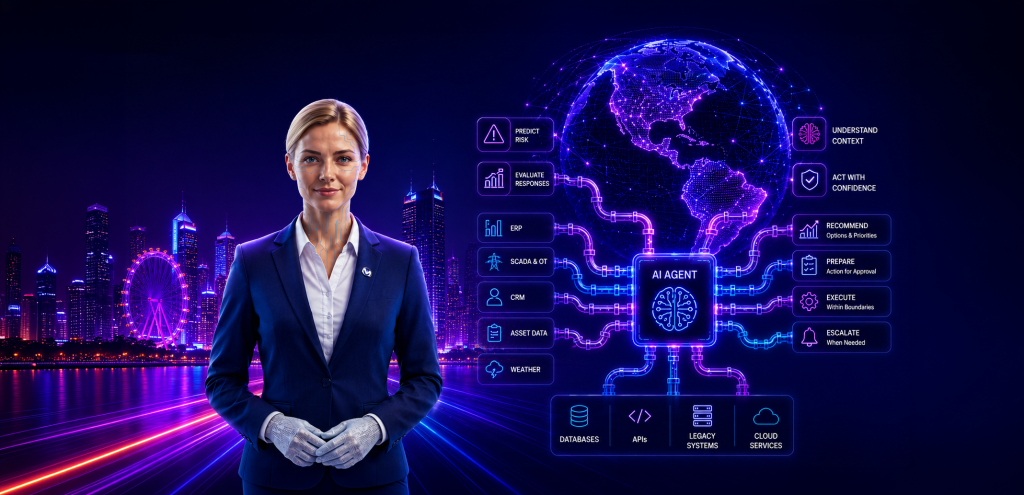
Data trapped in ERPs, CRMs, legacy databases, and multi-cloud repositories without unified semantics.
Disparate definitions across business units leading to conflicting metrics and low model confidence.
In this environment, AI struggles to deliver reliable insights because it lacks a complete and consistent view of the business.
The result is a growing disconnect between strategic ambition and operational reality: organizations aspire to enterprise intelligence, yet continue to operate on fragmented information.
03 Why Data Foundations Determine AI Outcomes
To understand why AI outcomes depend so heavily on the underlying data stack, business leaders must examine four critical dimensions:
Fragmentation Limits Enterprise Intelligence
Modern enterprises generate unprecedented volumes of data, but volume alone does not create value.
When customer, operational, financial, and supply chain data remain isolated across multiple systems, AI is forced to interpret incomplete business context. Decisions become narrower, insights less reliable, and opportunities harder to identify.
Data Quality Directly Influences Business Confidence
Executives do not measure AI success by the sophistication of algorithms. They measure it by the quality of business decisions AI enables.
Inaccurate, duplicated, outdated, or inconsistent data reduces confidence in AI outputs, slowing adoption across the organization. Without trusted information, even the most advanced AI capabilities struggle to gain executive acceptance.
Governance Has Become a Business Requirement
As AI becomes embedded in critical business processes, governance moves beyond regulatory compliance.
Organizations need confidence that data is secure, transparent, ethically managed, and aligned with evolving regulatory expectations. Strong governance enables organizations to scale AI responsibly while protecting business integrity, customer trust, and corporate reputation.
Legacy Architectures Restrict Business Agility
Many organizations continue to operate with data ecosystems designed for historical reporting rather than real-time intelligence.
As AI increases the demand for speed and contextual insights, these architectures create bottlenecks that delay decision-making and limit responsiveness. Modern enterprises require data platforms capable of continuously integrating, processing, and delivering trusted information across the business ecosystem.

04 Modern Data Foundations Enable Enterprise-Wide AI
Organizations achieving meaningful AI outcomes share a common characteristic: they have shifted their investment priorities beyond AI models toward modernizing the enterprise data ecosystem that powers them.
This transformation typically focuses on five strategic capabilities:
Connected Enterprise Data
Breaking down organizational silos to create a unified, business-wide view of customers, operations, products, and financial performance.
Trusted Information
Establishing consistent data quality, master data management (MDM), and metadata practices that improve executive confidence in business decisions.
Intelligent Governance
Embedding governance, security, data lineage, and compliance natively into the data lifecycle to support responsible, transparent AI adoption.
Scalable Integration
Connecting business applications, cloud platforms, partner ecosystems, and operational technologies through modern, API-driven integration frameworks.
Future-Ready Data Architecture
Building cloud-native, scalable data platforms capable of supporting advanced analytics, Generative AI models, and continuous autonomous innovation.
Collectively, these capabilities transform enterprise data into an enduring strategic asset.
05 Data Modernization Is No Longer an IT Initiative
Historically, data modernization has often been positioned as a technology transformation program. Today, it is increasingly an enterprise business transformation agenda.
Organizations with modern data capabilities are measurably better positioned across core business imperatives:
Conversely, organizations that postpone data modernization risk limiting the impact of every future AI investment.
06 A Strategic Imperative for Business Leaders
The conversation around AI is rapidly evolving. Success will no longer be defined by the number of AI pilots launched or the sophistication of individual models.
It will be determined by an organization's ability to operationalize AI consistently across the enterprise. That requires a foundation built on trusted data, modern architecture, strong governance, and connected business ecosystems.
Business leaders should therefore view data not as infrastructure, but as enterprise capital—an asset that determines how effectively organizations innovate, compete, and create long-term value.
The MOURI Tech Perspective
At MOURI Tech, we believe sustainable AI transformation begins with building a resilient and modern data foundation.
Our approach integrates data strategy, architecture modernization, intelligent governance, cloud transformation, and advanced analytics to help organizations create connected, trusted, and AI-ready enterprises.
By aligning data capabilities directly with business priorities, organizations can move beyond isolated AI experiments and establish the foundation for scalable innovation, operational excellence, and enduring competitive advantage.
07 Looking Ahead
The AI era will not be defined by access to technology. Technology is increasingly becoming accessible to everyone.
The true differentiator will be an organization's ability to transform enterprise data into business intelligence, operational agility, and strategic foresight.
The organizations that invest today in modern data foundations will be better positioned to innovate faster, make smarter decisions, and realize sustainable value from AI for years to come.
Because in the age of AI, the strongest competitive advantage is not artificial intelligence alone.
It is intelligent data.