
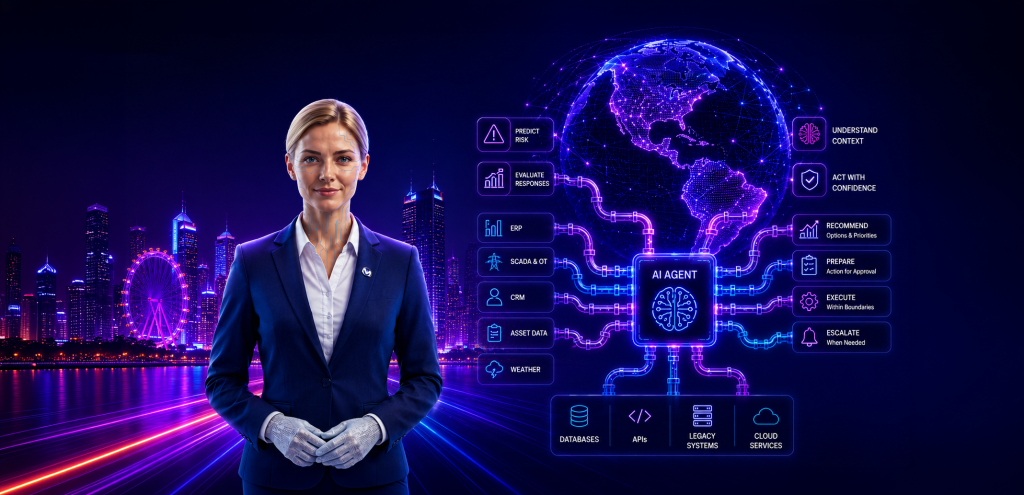
Modernizing grid operations through Autonomous Decision Intelligence, digital twins, and human-in-the-loop governance—moving from reactive event monitoring to trusted, contextual action.

Melanie Brown
For decades, utility control rooms have served as the operational heartbeat of the grid. Today, operators must manage increasingly dynamic conditions shaped by renewable generation, distributed energy resources, electric vehicles, changing demand patterns, and severe weather events.
Relevant information is often distributed across fragmented systems—grid-management, outage, asset, weather, geographic, and workforce tools—each designed for a different operational purpose.
The challenge facing modern utilities is no longer simply collecting operational data. It is connecting that information, understanding what matters in real time, and determining how conditions will develop. AI can help shorten the distance between visibility, interpretation, and action.
Beyond Automation: Autonomous Decision Intelligence
Utilities have automated routine workflows and adopted predictive analytics, but the next leap is Autonomous Decision Intelligence.
Decision intelligence introduces a fundamentally different capability: using operational data, analytics, and AI to detect emerging conditions, estimate possible outcomes, and present actionable response options.
The objective is not maximum autonomy for its own sake, but the appropriate level of autonomy for each operational decision.
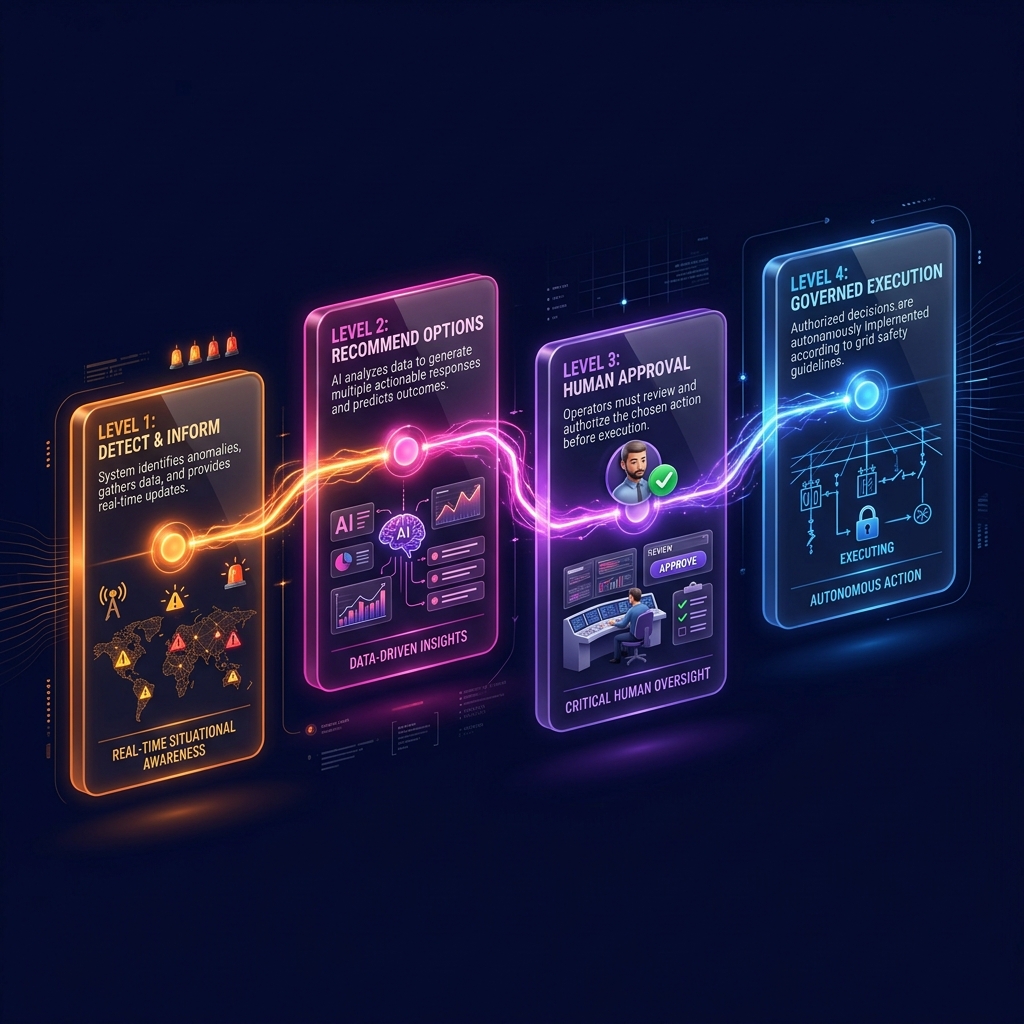
Depending on the risk involved, an AI-supported system may provide information, make a recommendation, prepare an action for human approval, or perform a narrowly defined action within established operating limits.
It is critical to emphasize that these levels of authority should not be treated as interchangeable. A system's ability to generate a recommendation does not automatically mean it should be permitted to execute that recommendation. Rather than replacing operators, AI becomes an intelligent operational partner.
From Monitoring Events to Understanding Context
Today's control rooms provide operators with extensive visibility into system conditions. The next generation can help them connect more of that information and evaluate how a situation may develop before it escalates.
During an approaching severe weather event, for example, an AI-supported system can combine weather forecasts, asset health indicators, historical outage data, network exposure, crew availability, and customer impact models to identify areas of elevated risk.
The system can then compare crew-positioning or restoration scenarios and present recommended priorities. Operators review the assumptions, consider competing operational requirements, and approve or modify the response.
The true value comes not from removing the human operator, but from providing more time and context before conditions become critical.
AI Agents as Collaborators & Natural Language Operations
Specialized AI agents can support narrowly defined control room activities such as monitoring asset conditions, consolidating alarm floods, retrieving operating procedures, preparing outage summaries, or coordinating information across authorized systems.
Their purpose is to reduce repetitive information gathering and help operators concentrate on decisions that require deep experience and judgment. Any agent with access to operational systems must function under strict permissions, escalation rules, and audit trails. Greater technical capability must not automatically result in unmonitored decision authority.
Furthermore, natural-language interfaces enable operators and leaders to retrieve information seamlessly across complex environments. An operator can ask which substations show elevated risk, request a summary of current operating conditions, or query the procedure for a specific outage event.
These interfaces must provide source attribution, timestamps, and explicit indications of uncertainty. Utilities must maintain a clear separation between conversational access to information and authorization to execute operational commands.
Digital Twins De-Risk Decisions & Explainable AI
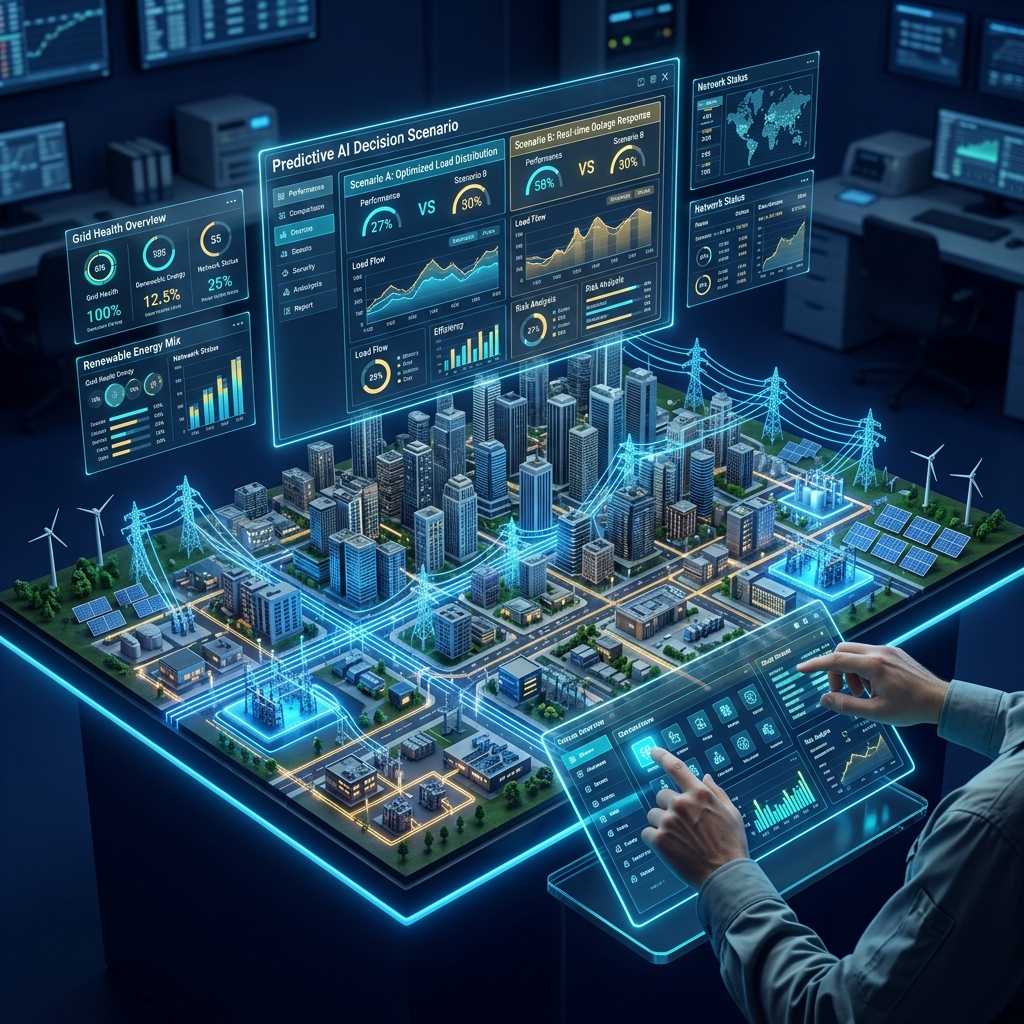
Paired with digital twins, AI lets utilities test decisions before making them. Operators can simulate restoration strategies, evaluate equipment stress, and estimate customer impacts across competing scenarios—seeing the likely outcome of an action before committing to it.
Mission-critical infrastructure requires more than a plausible recommendation. Explainable AI is non-negotiable. Operators need sufficient context to understand which conditions influenced the result, what data was used, where uncertainty remains, and whether the situation falls within the system's tested operating boundaries.
Auditability & Traceability
Utilities must be able to reconstruct which model and data produced a recommendation, who reviewed it, what action followed, and whether the outcome matched expectations.
Humans at the Center: Intentional Control Design
AI excels at processing vast streams of telemetry and detecting subtle patterns. Human operators contribute system intuition, deep operational experience, accountability, and the ability to recognize when live conditions deviate from model assumptions.
Human oversight should not be treated as a temporary limitation to be phased out. In critical grid infrastructure, it is an intentional, permanent part of control design.
Principles for the Future Control Room
1. Focus on Decisions
Start with the operational decision and business outcome, not the underlying AI technology.
2. Calibrated Autonomy
Assign the appropriate level of autonomy for each operational decision based on risk.
3. Human Control
Keep high-consequence operational actions strictly under human operator control.
4. Contextual Data
Build AI models on accurate, timely, and unified operational data foundations.
5. Continuous Audit
Validate, monitor, and audit all AI-supported recommendations in real time.
6. Operator Workflows
Design AI experiences around operator workflows, clarity, and accountability.
MOURI Tech’s Vision for the Future
At MOURI Tech, we bring together deep utilities domain expertise with capabilities across operational and enterprise integration, data engineering, AI, cloud, cybersecurity, digital twins, and quality engineering to help energy organizations modernize critical operations.
Through our strategic relationships across technology ecosystems including Microsoft Azure, AWS, Google Cloud, SAP, and Databricks, we help utilities connect fragmented environments, strengthen data foundations, and deploy intelligent capabilities within secure, governed architectures.
Our focus is not autonomy for its own sake, but practical solutions that help utilities anticipate risk, evaluate possible responses, and make more timely, accountable decisions.
Ai4 2026 · Energy & Utilities Innovation
Modernize Your Utility Control Room
Connect with MOURI Tech's Energy & AI Advisory team to explore how Autonomous Decision Intelligence can transform your grid operations.
Written by
Melanie Brown
Vice President – Utilities Growth & Partnerships at MOURI Tech
Melanie leads the Energy & Utilities Practice at MOURI Tech. She specializes in guiding power and utility enterprises through grid modernization, operational integration, digital twins, and governed AI deployment to build resilient, intelligent control room environments.