
Beyond Dashboards: Why Intelligent Decisions Will Define High-Performing Enterprises
Business leaders are moving beyond traditional reporting by combining predictive analytics, AI-assisted insights, and contextual intelligence to make faster, more confident decisions in an increasingly dynamic business environment.

Success is no longer determined by the ability to measure the business. It is increasingly determined by the ability to continuously guide the business. High-performing organizations are shifting from descriptive dashboard metrics to AI-augmented Decision Intelligence.
There was a time when dashboards transformed the way businesses operated.
For the first time, leaders could monitor business performance in near real time, measure operational efficiency through standardized KPIs, and gain visibility across functions that previously operated in silos. Business Intelligence became the foundation of executive reporting, enabling organizations to make more informed decisions than ever before.
That era is rapidly reaching its natural conclusion.
The challenge facing enterprises in 2027 is no longer access to information. Most organizations already possess more data than they can effectively consume.
The real differentiator is how quickly an organization can interpret change, evaluate competing scenarios, and make confident decisions before opportunities disappear or risks materialize.
01 Visibility Alone No Longer Creates Competitive Advantage
Over the last decade, organizations have invested heavily in dashboards, visualization platforms, enterprise reporting, and self-service analytics. Those investments delivered measurable improvements in transparency and operational control.
However, greater visibility has not necessarily translated into better decision-making.
Executives today spend significant time reviewing reports, yet many strategic decisions still rely heavily on experience, fragmented information, and manual interpretation.
The issue is not the availability of data. It is the growing gap between information and action.
Markets now evolve faster than reporting cycles. Customer expectations shift continuously. Supply chains remain unpredictable. AI is changing competitive dynamics across every industry.
In this environment, knowing what happened yesterday offers limited strategic value unless organizations can also determine what should happen next.
Analytics must therefore evolve from a measurement capability into a decision capability.
02 Organizations Are Transitioning from Measuring Performance to Anticipating Outcomes
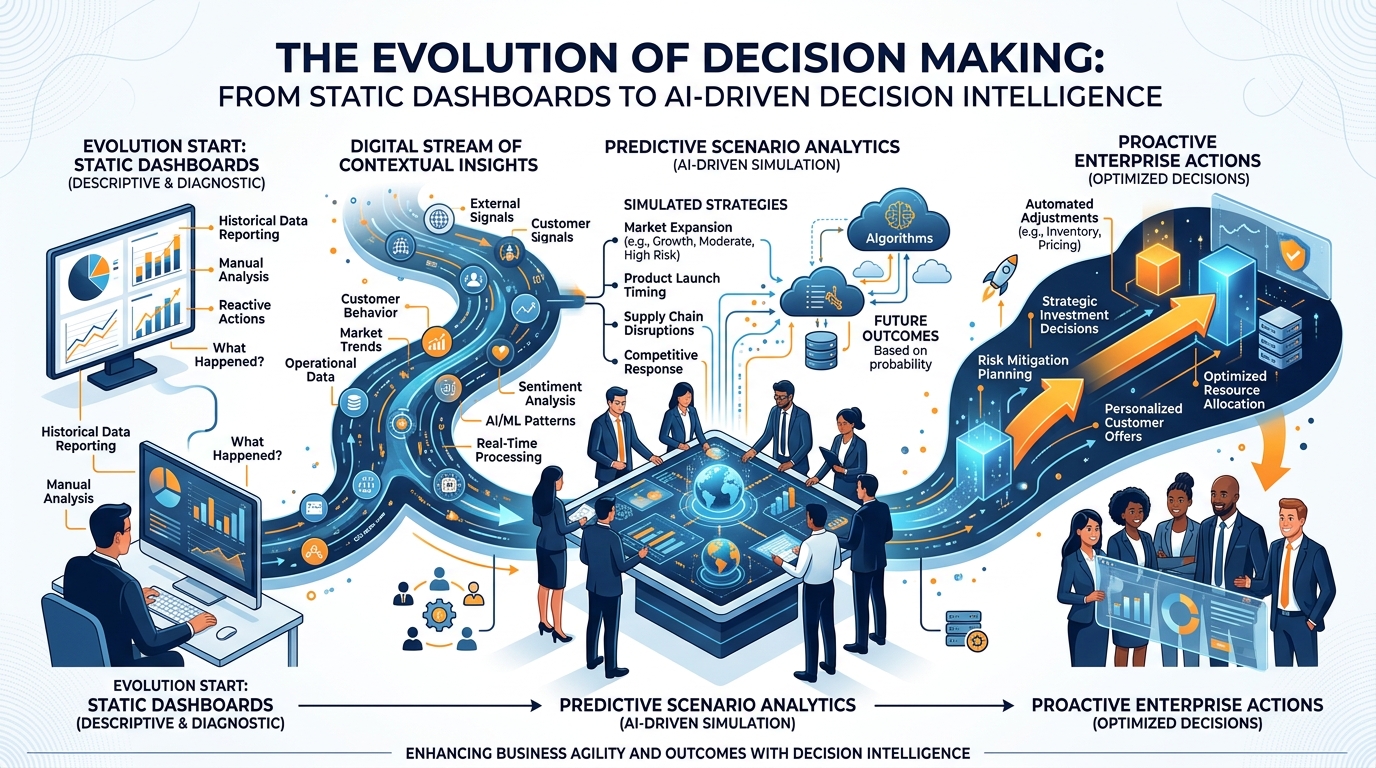
Historically, enterprise analytics focused on understanding past performance. Leadership teams relied on historical reports to evaluate financial performance, operational efficiency, sales effectiveness, and customer engagement.
That model assumes the future will largely resemble the past.
Increasingly, it does not.
Today's business environment demands analytics that identifies emerging trends before they become visible, predicts operational risks before they impact performance, and evaluates alternative business scenarios before strategic decisions are made.
Descriptive reporting, historical KPI rollups, retrospective quarterly reviews.
Predictive modeling, scenario simulation, proactive prescriptive guidance.
This evolution marks the decisive transition from descriptive reporting toward predictive enterprise management.
03 Artificial Intelligence Is Reshaping the Role of Analytics
Artificial Intelligence is often discussed in the context of automation. Its greater contribution, however, may be decision augmentation.
Rather than replacing human judgment, AI increasingly complements it by processing vast volumes of structured and unstructured information, recognizing patterns beyond human capability, and presenting recommendations supported by evidence.
This fundamentally changes how leaders engage with analytics:
From Manual Searching
Spending hours digging through disparate dashboard slices to spot hidden anomalies.
To Contextual Insights
Receiving emerging risk signals, recommended priorities, and quantified business impacts automatically.
Analytics becomes less reactive. Decision-making becomes significantly more proactive. The entire organizational emphasis shifts from finding insights to acting on them.
04 Predictive Organizations Will Outperform Reactive Organizations
One of the defining characteristics of high-performing enterprises over the next several years will be their ability to operate predictively.
Rather than responding to disruption after it occurs, predictive organizations continuously evaluate changing business conditions and adapt accordingly.
This capability systematically elevates every business function:
Demand Planning
Becomes more accurate by evaluating macro indicators, sentiment, and real-time consumption patterns.
Supply Chains
Become more resilient through early risk detection, dynamic routing, and automated supplier contingency modeling.
Customer Engagement
Becomes hyper-personalized, anticipating buyer intent before inquiries even enter traditional funnels.
Financial Planning
Becomes continuously dynamic, simulating capital allocations against multi-variable market conditions.
Operational Decisions
Become informed in real time, preventing downtime, service degradation, and costly process bottlenecks.
Prediction is no longer viewed as an advanced analytical capability. It is becoming a fundamental business expectation.
05 The Emergence of Decision Intelligence
Perhaps the most significant shift occurring within enterprise analytics is the emergence of Decision Intelligence.
Unlike traditional Business Intelligence, which primarily delivers information, Decision Intelligence focuses on improving the quality, consistency, and speed of business decisions.
Information-Centric
- Delivers static charts, tables & KPI dashboards
- Requires manual human interpretation
- Analyzes what happened in historical cycles
- Generates an overwhelming volume of passive data
Action-Centric
- Combines predictive analytics, AI recommendations & human expertise
- Delivers contextual options with evidence-backed tradeoffs
- Simulates scenarios to predict future impacts
- Surfaces the exact decisions that deserve immediate action
The objective is not to automate every decision.
The objective is to ensure every important decision is supported by the best available intelligence.
As organizations scale AI adoption, this capability becomes increasingly valuable. The challenge is no longer generating more insights—it is determining which insights deserve immediate action.
06 The Next Generation of Analytics Will Be Embedded, Contextual, and Continuous
Enterprise analytics is steadily moving away from standalone reporting environments. Instead, intelligence is becoming embedded directly into operational workflows.
Receive live recommendations while actively managing pipeline opportunities.
Evaluate scenario simulations and budget variance risks before approving investments.
Identify supply chain disruptions and mitigate vulnerabilities before service levels decline.
Receive continuous strategic guidance as macroeconomic and competitor conditions evolve.
Analytics no longer waits for questions. It continuously supports decision-making where decisions are actually made.
This embedded model significantly shortens the distance between insight and execution.07 Leadership Expectations Are Changing
The expectations placed on business leaders continue to evolve. Executives are no longer evaluated solely on strategic vision.
They are increasingly evaluated on how effectively they make decisions in environments characterized by uncertainty, complexity, and constant change.
This requires a fundamentally different analytical mindset:
Decision quality is becoming a measurable leadership capability.
08 Building Decision-Centric Enterprises
As organizations prepare for the next phase of digital transformation, the conversation should move beyond dashboards and reporting modernization.
The more important discussion is how enterprises can redesign decision-making itself.
This involves integrating predictive analytics into core business processes, expanding access to AI-assisted insights, strengthening governance around business decisions, and creating an operating model where intelligence continuously informs execution.
The Clarity Advantage
Organizations that succeed will not necessarily possess more sophisticated technology than their competitors. They will possess greater organizational clarity.
Their leaders will spend less time searching for answers and more time acting with confidence.
In the coming years, competitive differentiation will increasingly depend on how effectively organizations transform analytics into decisive business action.
The MOURI Tech Perspective
At MOURI Tech, we partner with enterprise leaders to transition from passive dashboard consumption to active Decision Intelligence frameworks.
By unifying transactional data fabrics, embedding predictive simulation models, and designing contextual decision workflows, we help organizations accelerate decision velocity and operational resilience.
Transforming data into decisive competitive advantage requires more than new visualization tools—it requires an enterprise operating model engineered for action.
Because the future of analytics is not about seeing more.
It is about deciding better.